

Taking vLLM Apart: A Practical Guide to Disaggregated Serving
A single vllm serve process does three jobs that get in each other's way: processing prompts (prefill), generating tokens (decode) and a pile of CPU work around them. Disaggregated serving in vLLM separates the different stages of LLM inference. Splitting prefill from decode stops long prompts stalling everyone else's output, as long as the KV cache moves between them fast. Moving tokenization and parsing to a CPU-only frontend (/render, /derender) takes that work off your GPU nodes and leaves the engine working purely in token IDs. This post covers when each split or separation is worth using, how to run it with vLLM v0.31.0 or later, and the key gaps and improvements still ahead.
One Server Doing Three Unrelated Jobs
Start a plain vllm serve and you get one process handling three workloads that have nothing in common.
One long prompt arrives while dozens of requests are mid-response and every one of those streams stutters until it's processed. It's the spike you see the moment concurrency goes up. The cause is two phases with little in common sharing one GPU. Prefill reads the whole prompt in one pass, is limited by compute and sets your time to first token (TTFT). Decode is the opposite. It produces one token at a time and what holds it back is how fast the GPU can read the model weights from memory which sets your inter-token latency (ITL). Put them on the same GPU and every decode stream waits while a long prefill runs.
The third job however is quieter and easier to miss. Chat templating, tokenization, detokenization, reasoning parsing, tool call parsing. All pure CPU work running on a box you're renting for its accelerators.
Disaggregation is the obvious response: stop making one process do all of it. If you want the vLLM engine level picture before you go further, Inside vLLM covers how the scheduler mixes prefill and decode today and has a short section on P/D.
The Dimensions
vLLM offers several points where work can be split and they can be combined.
Prefill and decode run as two instances. What passes between them is the KV cache: the attention keys and values for every prompt token which decode needs before it can emit anything. It's big. Llama-3.1-70B in BF16 stores 320 KiB per token, so a 10k-token prompt hands decode about 3 GB. That's roughly 65 ms at a 400 Gb/s line rate before any overhead and all of it lands on TTFT. A KV connector moves it, usually over RDMA. There are more than a dozen connectors upstream now, including NIXL, LMCache, Mooncake, FlexKV and AMD's MoRI-IO, plus a MultiConnector that chains them.
The frontend comes off the GPU box entirely. /render turns an OpenAI request into token IDs, the engine runs token-in / token-out and /derender turns the output token IDs back into a proper OpenAI response with content, reasoning and tool_calls split out. That last leg only landed recently and it completes the round trip.
Beyond P/D, there's encoder disaggregation for multimodal and the AFD plugin for splitting attention from FFN in MoE models. Both use the same idea at a different point in the model. P/D itself now also covers hybrid SSM models with Mamba state transfer included.
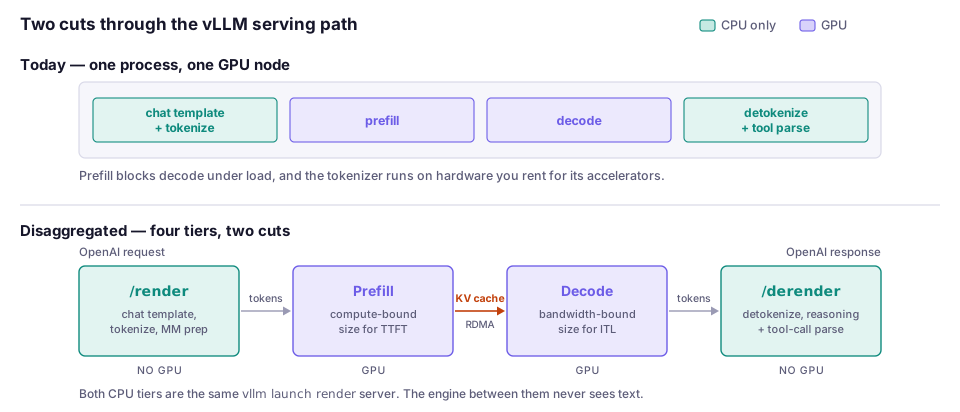
Figure 1. One process doing everything, versus the same pipeline cut into four tiers.
What It Buys You and What It Costs
The pitch isn't peak throughput. With no latency target, splitting the same GPUs into prefill and decode pools won't necessarily move more tokens per second. What it buys is goodput: the request rate you can sustain while requests still meet both their TTFT and ITL targets.
You can tune TTFT and ITL independently. Different parallelism on each tier, sized for the phase it's running. Prefill can be TP-heavy, decode can be sized for batch. Neither change drags the other one with it.
Tail latency stays low as load climbs. A decode instance that only runs decode batches never has a long prefill stall its streams. Chunked prefill gets you partway there, but the right chunk size depends on the traffic, so you end up retuning it.
This was measured on one box with two NVIDIA L40S GPUs (48 GB, PCIe, no NVLink): Qwen2.5-7B-Instruct, ~8k-token prompts, 256 output tokens, 100 Poisson-arrival requests per rate, prefix caching off. Collocated is one vllm serve --data-parallel-size 2, so both setups get the same two GPUs. That isn't the strongest collocated baseline because DP ranks can hold each other up and two independent replicas behind a load balancer might do a little better. P/D is one prefiller and one decoder over NIXL behind the example proxy.
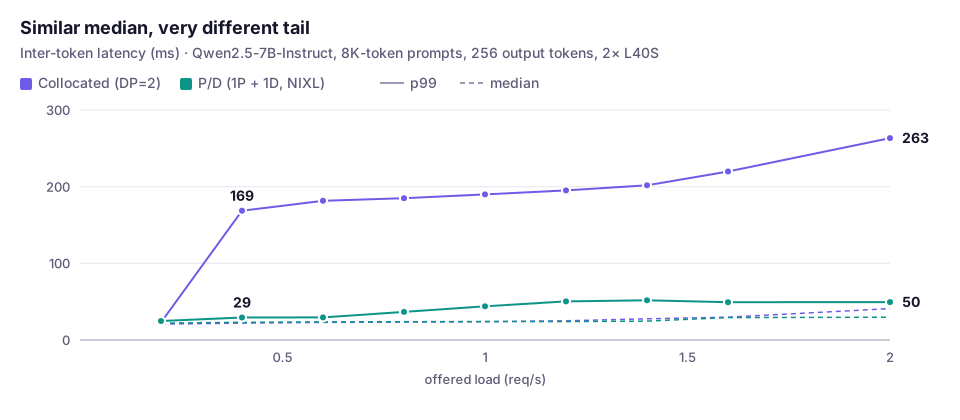
Figure 2. Median ITL is 21–24 ms in both setups up to 1 req/s. At 0.4 req/s, collocated p99 jumps to 169 ms while P/D holds at 29 ms and never exceeds 52 ms.
At 0.4–0.6 req/s the medians match and the collocated p99 is about six times higher. That's 8k-token prefills landing on a GPU that's also decoding and stalling every stream on it until they finish. P/D keeps them off the decode GPU entirely.
Goodput goes up when the transfer is fast. AMD's single-node MoRI-IO benchmark ran Qwen3-235B-A22B-FP8 at 8 req/s on one 8-GPU MI300X node. 73 of 100 requests met both a 1 s TTFT and a 50 ms ITL target, against 30 of 100 for collocated serving. That's about 2.4× the goodput on the same hardware. At cluster scale, llm-d's P/D guide reports about 59% lower mean end-to-end latency and 67% lower P95 for gpt-oss-120b on 16 H200s, compared with the same GPUs run as aggregated replicas.
Every first token pays for the transfer. Those results assume the KV cache moves fast: RDMA over InfiniBand or RoCE between nodes, NVLink or GPU peer-to-peer within one. Our test box had neither. The L40S pair can't do peer-to-peer copies (nvidia-smi topo -p2p r reports NS) and each 8k prompt's ~470 MB of KV cache (56 KiB per token for Qwen2.5-7B) took about 1.3 s to reach decode. At 0.2 req/s, P/D median TTFT was 2.2 s against 0.7 s collocated, so it missed a 2 s TTFT target at every rate even though its ITL tail stayed flat. Bandwidth alone doesn't explain 1.3 s. Even staged through host memory, PCIe 4.0 should move that in tens of milliseconds. Most of it is overhead around the copy, including decode only noticing a finished transfer when it polls between its own forward steps.
So check the transfer before you benchmark anything else. On one box, nvidia-smi topo -p2p r should say OK between your prefill and decode GPUs. Then send a few long prompts one at a time and read decode's KV Transfer metrics line. If Avg xfer time is in the hundreds of milliseconds, fix that first.
The CPU tier is cheap. Once tokenization and parsing move off the GPU box, you scale them against CPU load instead of buying accelerator time to run a tokenizer. Long prompts, multimodal preprocessing and reasoning or tool parsing are where the render tier does real work and none of it needs a GPU. On the same box, templating and tokenizing a 9k-token chat prompt for Qwen2.5-7B cost about 15 ms of CPU. One render server with default settings topped out at 73 req/s using just over one core. At the 0.4 req/s where collocated's tail fell apart, rendering is under 1% of one core.
The catch: you now operate three or four services instead of one and the KV transfer is a new failure mode. Collocated is still the right answer for plenty of deployments.
| Your situation | Recommendation |
|---|---|
| ITL p99 misses your SLO under production load | Disaggregate. This is the main use case. |
| Long prompts at high concurrency | Disaggregate, if your KV transfer is fast. Prefill interference is worst here. |
| Chat or agent loops over a growing context | Disaggregate, with bidirectional transfer (below). Pair it with KV offloading or a shared KV cache such as LMCache or Mooncake. |
| Templating, tokenizing or parsing shows up in your GPU nodes' CPU profile | Split off the render tier. |
| TTFT is the binding constraint | Stay collocated or measure first. The transfer lands on every first token. |
Your KV transfer is slow (check decode's KV Transfer metrics) | Fix it or stay collocated. It lands on TTFT and caps throughput. Check the fabric too, since a misconfigured network usually slows collectives as well. |
| Low, bursty or latency-insensitive traffic | Stay collocated. |
Running Prefill/Decode
Everything from here on assumes vLLM v0.31.0 or later. The examples use Qwen3-0.6B because it loads fast. That's fine for checking the wiring but it's too small to show a P/D benefit, so benchmark with a larger model (see Where to start).
Three processes: prefiller, decoder, proxy.
# Prefiller on GPU 0
CUDA_VISIBLE_DEVICES=0 UCX_NET_DEVICES=all VLLM_NIXL_SIDE_CHANNEL_PORT=5600 \
vllm serve Qwen/Qwen3-0.6B --port 8100 \
  --kv-transfer-config '{"kv_connector":"NixlConnector","kv_role":"kv_producer"}'

# Decoder on GPU 1
CUDA_VISIBLE_DEVICES=1 UCX_NET_DEVICES=all VLLM_NIXL_SIDE_CHANNEL_PORT=5601 \
vllm serve Qwen/Qwen3-0.6B --port 8200 \
  --kv-transfer-config '{"kv_connector":"NixlConnector","kv_role":"kv_consumer"}'

# Proxy
python tests/v1/kv_connector/nixl_integration/toy_proxy_server.py --port 8192 \
  --prefiller-hosts localhost --prefiller-ports 8100 \
  --decoder-hosts localhost --decoder-ports 8200
The proxy is what ties them together. For each request it calls prefill first, with max_tokens=1 and kv_transfer_params: {"do_remote_decode": true}. Prefill computes the KV cache, holds the blocks and returns kv_transfer_params that point at them. The proxy then forwards the original request to decode with those params attached and decode pulls the blocks over NIXL before it generates.
Point your client at 8192 and it looks like any other OpenAI endpoint. The proxy in tests/ is an example that's fine for development but not for production. For production, look at llm-d or Dynamo.
Three settings worth knowing early. VLLM_NIXL_SIDE_CHANNEL_PORT must be unique per worker on a host. kv_lease_duration (set in kv_connector_extra_config, default 30s) controls how long the prefiller holds blocks waiting for the decoder to collect them. Under load, that's the timeout you'll be tuning. And kv_load_failure_policy decides what happens when a transfer fails: fail, the default, errors the request, while recompute has decode recompute the missing KV itself. Slower, but the request survives.
One easy win if you're running P/D on /v1/chat/completions: the prefill stage already tokenized the prompt, so the decode stage doesn't need to do it again. Ask for return_token_ids on prefill, then hand the IDs to decode through kv_transfer_params. This is the same two step call the proxy makes and the token IDs are the only new part:
from openai import OpenAI

MODEL = "Qwen/Qwen3-0.6B"
messages = [{"role": "user", "content": "What is 17 * 23?"}]

prefill_client = OpenAI(base_url="http://localhost:8100/v1", api_key="EMPTY")
decode_client = OpenAI(base_url="http://localhost:8200/v1", api_key="EMPTY")

prefill = prefill_client.chat.completions.create(model=MODEL, messages=messages, max_tokens=1,
    extra_body={"return_token_ids": True, "kv_transfer_params": {"do_remote_decode": True}})

# prefill's kv_transfer_params point decode at its blocks; add the token IDs on top
decode = decode_client.chat.completions.create(model=MODEL, messages=messages, stream=True,
    extra_body={"kv_transfer_params": {**prefill.kv_transfer_params,
                                       "prompt_token_ids": prefill.prompt_token_ids}})
Once it works, sizing it is the hard part. The Qwen3.8-2.4T PD post walks through picking prefill and decode topologies from KV cache capacity up.
Multi-Turn: Stop Recomputing the Conversation
Standard P/D moves the cache one way which is wasteful for chat and agent loops. On turn two, decode still holds KV for the answer it just generated but prefill has never computed it, so prefill recomputes it. With bidirectional_kv_xfer set on both instances, prefill pulls those blocks back from decode instead and computes only the new tokens. A proxy tracks which blocks belong to which conversation, keyed by a conversation_id the client sends. The bi-directional KV transfer post covers setup, tuning and benchmarking in depth.
One warning for reasoning models. Decode's blocks include the thinking traces it generated. If the next turn's prompt drops them, as Qwen3's chat template does on its own, prefill's prompt no longer lines up with decode's blocks and you get wrong output, not just slow output. Nothing in vLLM catches that mismatch today (#43094), so check your chat template before you turn this on.
Running the GPU-Less Frontend
Taking CPU work off the GPU box is only part of it. Once the engine takes token IDs in and gives token IDs out, it doesn't need the chat template or the parsers any more, and the caller gets to see and use the token IDs. A router can render a request, then pick a replica on prefix cache hits for the real prompt tokens rather than guessing from text. RL and eval pipelines get the exact IDs the model saw and produced, which matters because decoded text doesn't always re-tokenize the same way.
Multimodal preprocessing moves too. Image decoding and the model's processor run on the render tier and with encoder disaggregation, render sends the processed tensors to the encoder and just the metadata to prefill. The processed payload can be much bigger than the source image, so size your request limits for it.
Two servers: a render tier with no GPU and an engine that speaks tokens only. The parsers go on the render server since that's where derender runs them.
vllm launch render Qwen/Qwen3-0.6B --port 8100 \
  --reasoning-parser qwen3 --enable-auto-tool-choice --tool-call-parser hermes
vllm serve Qwen/Qwen3-0.6B --tokens-only --port 8200
Both of those modes always expose their scale-out endpoints. On a regular vllm serve they're off by default. If you want /render, /derender or /inference/v1/generate on a server that also takes normal OpenAI traffic, add --enable-scale-out.
Then it's three hops — render, generate, derender:
import httpx

MODEL = "Qwen/Qwen3-0.6B"
RENDER = "http://localhost:8100"  # vllm launch render
ENGINE = "http://localhost:8200"  # vllm serve --tokens-only

chat_request = {
    "model": MODEL,
    "messages": [{"role": "user", "content": "What is 17 * 23?"}],
    "max_tokens": 2048,
}

with httpx.Client(timeout=60.0) as client:
    # 1. request -> token IDs (no GPU)
    generate_request = client.post(f"{RENDER}/v1/chat/completions/render", json=chat_request).json()

    # 2. token IDs -> token IDs (GPU)
    generate_response = client.post(f"{ENGINE}/inference/v1/generate", json=generate_request).json()

    # 3. token IDs -> ChatCompletionResponse (no GPU)
    response = client.post(f"{RENDER}/v1/chat/completions/derender", json={
        "model": MODEL,
        "generate_response": generate_response,
        "prompt_tokens": len(generate_request["token_ids"]),
        "chat_request": chat_request,
    }).json()

message = response["choices"][0]["message"]
print(message["reasoning"], message["content"], sep="\n---\n")
Pass chat_request back into the derender step. The parsers need the original context (tools, tool_choice, include_reasoning) to produce the same content / reasoning / tool_calls split a normal vllm serve would. On a model with a parser configured, leaving it out gets you a 400 rather than a silent fallback that leaks <tool_call> markup into content.
Streaming
Both endpoints also take stream: true. /render keeps stream on the request it returns, so generate streams too, and each generate chunk goes through derender on its own. Continuing the example above:
import json

chat_request = {**chat_request, "stream": True}

with httpx.Client(timeout=60.0) as client:
    generate_request = client.post(f"{RENDER}/v1/chat/completions/render", json=chat_request).json()
    prompt_token_ids = generate_request["token_ids"]

    stream_state = None  # one per choice index if n > 1
    with client.stream("POST", f"{ENGINE}/inference/v1/generate", json=generate_request) as stream:
        for line in stream.iter_lines():
            if not line.startswith("data: ") or line == "data: [DONE]":
                continue
            derendered = client.post(f"{RENDER}/v1/chat/completions/derender", json={
                "stream": True,
                "model": MODEL,
                "generate_chunk": json.loads(line[len("data: "):]),
                "stream_state": stream_state,
                "prompt_tokens": len(prompt_token_ids),
                "prompt_token_ids": prompt_token_ids,
                "chat_request": chat_request,
            }).json()
            stream_state = derendered["stream_state"]
            for choice in derendered["chunk"]["choices"]:
                print(choice["delta"].get("content") or "", end="", flush=True)
Send stream_state as null on the first call and echo back whatever the last response gave you. chat_request and prompt_token_ids go with every chunk because the server keeps nothing between calls. Because of that, any render replica can handle any chunk. It's also where the cost comes from once a parser is involved (see What's still left).
Deploying the Render Tier
The render tier holds no per-request state, even when streaming, so it scales like any stateless web service. Put replicas behind an ordinary load balancer and scale them on CPU, independently of the GPU pool.
Keep the config in sync. Render, derender and the engine have to agree on the model, tokenizer, chat template and parser flags (--chat-template, --default-chat-template-kwargs, --reasoning-parser, --tool-call-parser, --enable-auto-tool-choice). A mismatch doesn't raise an error. You just get a different content / reasoning / tool_calls split from what vllm serve would return.
Then size the thread pool. Templating, tokenization, multimodal preprocessing and streaming parser replay all run on the renderer's workers, set by --renderer-num-workers, which defaults to 1. Plain rendering is cheap (about 15 ms of CPU for the 9k-token prompt above). Streaming a reasoning or tool-calling model through a parser costs a lot more, so raise the worker count or add replicas to match your concurrent parsed streams.
Putting Both Splits Together
Figure 1 shows both splits at once: four tiers, but only three servers since one vllm launch render server handles both /render and /derender. Nothing upstream drives the four hops for you yet but the pieces combine because /inference/v1/generate accepts kv_transfer_params just like /v1/chat/completions does.
# Render and derender, no GPU
vllm launch render Qwen/Qwen3-0.6B --port 8000 \
  --reasoning-parser qwen3 --enable-auto-tool-choice --tool-call-parser hermes

# Prefill on GPU 0
CUDA_VISIBLE_DEVICES=0 UCX_NET_DEVICES=all VLLM_NIXL_SIDE_CHANNEL_PORT=5600 \
vllm serve Qwen/Qwen3-0.6B --tokens-only --port 8100 \
  --kv-transfer-config '{"kv_connector":"NixlConnector","kv_role":"kv_producer"}'

# Decode on GPU 1
CUDA_VISIBLE_DEVICES=1 UCX_NET_DEVICES=all VLLM_NIXL_SIDE_CHANNEL_PORT=5601 \
vllm serve Qwen/Qwen3-0.6B --tokens-only --port 8200 \
  --kv-transfer-config '{"kv_connector":"NixlConnector","kv_role":"kv_consumer"}'
Your code then plays the proxy's part between render and derender:
import httpx

MODEL = "Qwen/Qwen3-0.6B"
RENDER, PREFILL, DECODE = "http://localhost:8000", "http://localhost:8100", "http://localhost:8200"

chat_request = {
    "model": MODEL,
    "messages": [{"role": "user", "content": "What is 17 * 23?"}],
    "max_tokens": 2048,
}

with httpx.Client(timeout=60.0) as client:
    # 1. Render: request -> token IDs (no GPU)
    generate_request = client.post(f"{RENDER}/v1/chat/completions/render", json=chat_request).json()

    # 2. Prefill: compute the KV cache, generate one token, hold the blocks
    prefill_response = client.post(f"{PREFILL}/inference/v1/generate", json={
        **generate_request,
        "sampling_params": {**generate_request["sampling_params"], "max_tokens": 1},
        "kv_transfer_params": {"do_remote_decode": True},
    }).json()

    # 3. Decode: pull prefill's blocks over NIXL, then generate
    generate_response = client.post(f"{DECODE}/inference/v1/generate", json={
        **generate_request,
        "kv_transfer_params": prefill_response["kv_transfer_params"],
    }).json()

    # 4. Derender: token IDs -> ChatCompletionResponse (no GPU)
    response = client.post(f"{RENDER}/v1/chat/completions/derender", json={
        "model": MODEL,
        "generate_response": generate_response,
        "prompt_tokens": len(generate_request["token_ids"]),
        "chat_request": chat_request,
    }).json()

message = response["choices"][0]["message"]
print(message["reasoning"], message["content"], sep="\n---\n")
Step 2 is the same trick the proxy uses: a one-token budget plus do_remote_decode, so prefill computes the KV cache and holds on to the blocks. Step 3 hands decode the kv_transfer_params prefill returned which point at those blocks. The example proxy only handles /v1/completions and /v1/chat/completions, so in production this orchestration is yours to write. It's also the job of llm-d and Dynamo which the renderer docs name as its intended callers.
Who's Actually Running This
llm-d uses vLLM's native remote prefill/decode and NIXL KV-transfer capabilities. llm-d's router and EPP scheduler choose the prefill/decode endpoints and orchestrate the KV-cache handoff between them. NVIDIA Dynamo runs vLLM on Kubernetes in aggregated or disaggregated mode with its own router and planner. KServe exposes it through LLMInferenceService, built on llm-d.
The vLLM production stack ships disaggregated prefill via Helm and AIBrix covers the control plane side. On the connector side, Moonshot's Mooncake, LMCache and AMD's MoRI-IO are all upstream. And because decode sits behind a connector, it doesn't even have to be vLLM: TileRT pairs stock vLLM prefill with its own latency optimized decode engine.
What's Still Left To Do?
Streaming derender with a parser is expensive. Reasoning and tool parsers hold state that can't be serialized, so each chunk rebuilds a fresh parser and replays the token history through it. Transport is O(n) per chunk, replay is O(n) parse calls per chunk and parse_delta itself rescans accumulated text for parsers like Hermes and DeepSeek-R1. That's O(n³) character work over a long generation. A benchmark on multi-thousand-token reasoning output measured roughly 9× the in-process CPU at matched load and +15% on E2E p50. A caching layer is scheduled (#57571). Until it lands, a render tier left at one worker saturates under concurrent parsed streams, so size it as described above.
Long prompts dominate the wire. The parser path resends prompt_token_ids in full on every chunk. A 100k-token prompt with 1k tokens of output means the prompt is ~99% of each request body. Plain detokenization without a parser doesn't have this problem.
Some small correctness gaps are being worked on. Batch derender doesn't always return finish_reason: "tool_calls" when it parses tool calls (fix pending in #47931) and it mints its own tool call IDs instead of keeping the parser's. Logprobs come back from the tokenizer free engine as "token_id:N" placeholder strings which works but isn't ideal. #57574 proposes returning real integer token IDs.
One design question is still open. #56851 asks whether /inference/v1/generate should just return text or derendered output directly, skipping the third hop for callers who don't need it.
The umbrella RFCs are #42729 (detokenization batch), #47161 (detokenization streaming), #22817 (tokens-in, tokens-out) and #34407 (disaggregated frontend). Please weigh in on the RFCs and let us know what you think.
Where To Start
If you've got two GPUs, run the NIXL example above with a 7B-class model. Qwen3-0.6B prefills so fast that it barely disturbs decode, so there's nothing for P/D to fix. Check the transfer first, as discussed above. Then run the same benchmark against the proxy on 8192 and against one collocated vllm serve --data-parallel-size 2 on the same two GPUs, and compare p99 ITL, TTFT and goodput. Step --request-rate up until the collocated server's p99 ITL falls apart. With 8k prompts on the test box that was 0.4 req/s. Start every server with --no-enable-prefix-caching if you reuse a --seed across rates. Otherwise later rates replay prompts the server has cached and the cache hits hide exactly the prefill interference you're trying to measure.
vllm bench serve --model Qwen/Qwen2.5-7B-Instruct --port 8192 \
  --dataset-name random --random-input-len 8192 --random-output-len 256 --ignore-eos \
  --request-rate 0.4 --num-prompts 100 \
  --percentile-metrics ttft,tpot,itl --metric-percentiles 50,99 \
  --goodput ttft:2000 tpot:30
Serving chat or agents? Turn on bidirectional_kv_xfer and measure TTFT on turn five, not turn one.
If you're already on Kubernetes, start from llm-d or Dynamo rather than building a proxy yourself. And if you're running a reasoning or tool-calling model through streaming derender, benchmark the render tier before you size it — that's the part most likely to surprise you.
Docs: disaggregated prefilling, NixlConnector, renderer, derenderer.
Acknowledgements
Thanks to @aoshen02, Bongwoo Bak, Chauncey, Guan-Ming Chiu, Hyunkyun Moon, Konstantin Dunas, Maroon Ayoub, Nick Hill, Nicolò Lucchesi, Nithin Chalapathi, Robert Shaw, Sagi Ahrac, Seiji Eicher, @snadampal, Will Eaton, Yuqi Wang, and Yuge Zhang, as well as others in the vLLM community for helping deliver disaggregated serving.