

MiniMax H3 on vLLM-Omni: From System-Wide Optimization to Real-Time Serving with FastVideo’s FastH3
A two-stage optimization story: first reduce overhead across the complete MiniMax H3 serving stack, then integrate FastVideo's four-step FastH3 for complete-MP4 generation faster than playback.
MiniMax H3 serving is a system problem. One request crosses a large Qwen3-VL encoder, a long-sequence audio-video DiT, separate video and audio VAEs, device and process boundaries, and finally H.264/AAC construction. Optimizing only the DiT leaves substantial latency elsewhere.
vLLM-Omni therefore starts with the complete resident pipeline: attention and communication, fused DiT operators, parallel VAE decoding, compact output transport, and parallel MP4 construction. FastVideo's FastH3 then attacks the remaining dominant term by replacing 49 DiT forwards with four.
On the measured eight-B300 profile, FastH3 produced a complete 10.125-second MP4 in 8.678-8.710 seconds. Throughout this post, real-time means the complete response is ready faster than its playback duration. It does not mean streaming delivery or time to first frame.
1. Why MiniMax H3 serving is a system-wide problem
MiniMax H3 jointly generates video and synchronized audio from text, images, videos, and audio references. Its components have different compute, memory, and placement requirements:
request -> encoder -> joint audio/video DiT -> video + audio VAEs
        -> GPU output preparation -> D2H/IPC -> H.264/AAC MP4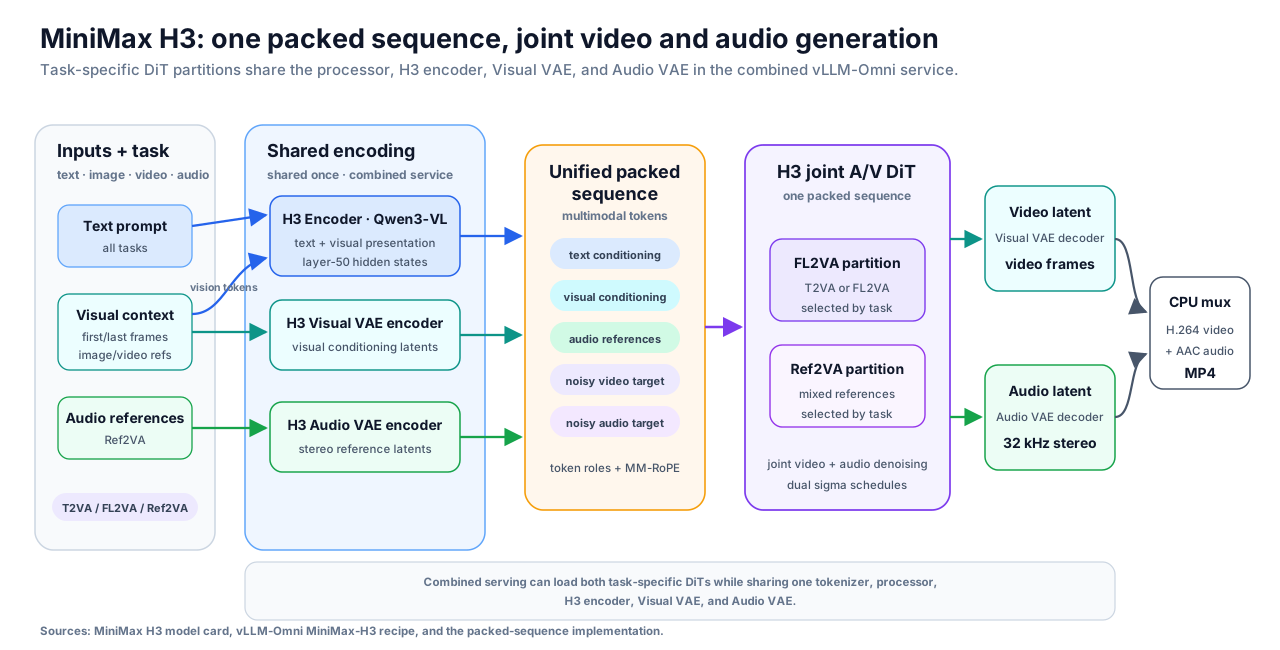
Figure 1: Text uses the H3/Qwen3-VL encoder; visual and audio conditions also use their corresponding VAEs. Conditioning and noisy target latents form one packed sequence for joint audio-video denoising, followed by separate decode and MP4 construction. Sources: the MiniMax H3 model card, vLLM-Omni recipe, and Diffusers pipeline.
The released checkpoints cover three serving tasks:
| Task | Inputs | Typical use |
|---|---|---|
| T2VA | Text | Creative generation and synthetic media |
| FL2VA | Text plus first/last images | Controlled transitions and image animation |
| Ref2VA | Mixed image, video, and audio references | Consistent editing and reference-guided generation |
The DiT dominates the base schedule, but it is not the only bottleneck. Encoder residency affects capacity; VAE decode becomes visible after denoising is shortened; and raw frames must still cross process boundaries and become an MP4. That is why the story begins with system-wide optimization.
2. Benchmark contract and evidence boundaries
The article keeps two evidence lanes separate:
| Evidence lane | Purpose |
|---|---|
| Base H3: Diffusers versus vLLM-Omni | Measure system-wide runtime optimization under a 50-point dense BF16 schedule |
| FastH3 duration sweep | Measure absolute low-latency and complete-response real-time behavior with four DiT forwards |
The two lanes use valid, frozen experiments, but not the same source SHA, prompt, seed, and artifact. We therefore do not derive a base-to-FastH3 speedup. The article reports the absolute FastH3 latency until a matched A/B is available.
2.1 Frozen controls
| Control | Base H3 system lane | FastH3 lane |
|---|---|---|
| Hardware | 8x NVIDIA B300 | 8x NVIDIA B300 |
| Task | T2VA through FL2VA partition | Dense/Data-Free T2VA only |
| Resolution / FPS | 1344x768 / 24 FPS | 1344x768 / 24 FPS |
| Source | vLLM-Omni b81aeb7 | vLLM-Omni 86b85c07 |
| Model | MiniMax H3 42ed227e | Same base model plus pinned FastH3 artifact |
| Prompt / seed | Official case-T2VA expanded prompt, SHA-256 98f36b...f06; seed 0 | Fixed FastH3 prompt; seed 1101 |
| Schedule | 50 sigma points / 49 DiT forwards | 5 sigma points / 4 DiT forwards |
| Topology | Encoder TP8; DiT USP8, Ring1; VAE PP8 tile | One replica; encoder TP8; DiT USP8, Ring1; VAE PP8 tile |
| Attention | Dense BF16 TRTLLM_ATTN, Fast Ulysses | Dense TRTLLM_ATTN, Fast Ulysses |
| Repetitions | One excluded full-shape warmup, then measured requests | One excluded feasibility request per shape, then two interleaved runs per duration |
Both lanes time from synchronous request submission through receipt of the complete MP4. Downloads, startup, compilation, and the excluded warmup are outside that interval. Every accepted output must decode as H.264 video plus stereo 32 kHz AAC, contain the expected frame count and FPS, have nonzero video variance and audio RMS, and pass prompt-adherence review.
For FastH3, retain the validated video and audio stream durations and define
T_media = max(T_video, T_audio), the effective complete-MP4 playback duration:
RTF_client = T_client / T_media
RTF_client <= 1.0 is the complete-response real-time criterion. A failed
media check, missing audio, OOM, accelerator error, or unexpected fallback
stops that profile before repeated measurement.
Other hardware is intentionally recipe coverage rather than another result matrix: H200 and datacenter CUDA, RTX PRO 5000, RTX 4090, RTX 5090, GB10, and ROCm.
3. System-wide optimization with vLLM-Omni
The base H3 lane preserves released BF16 weights, 50 sigma points, and dense attention coverage. The optimizations follow the execution path rather than a feature catalogue.
3.1 Long-sequence attention and communication
H3 denoises text, audio, and video tokens as one long packed sequence. For the canonical workload, 58,758 valid tokens occupy a 58,816-token aligned buffer. vLLM-Omni reduces overhead at three boundaries:
TRTLLM_ATTNreceives valid sequence lengths, and packed-sequence refinement removes structural suffix padding.- Rank-local boundaries construct only local embedding/RoPE rows and gather the compact 128-channel projection rather than the 5,376-channel hidden state.
- Fast Ulysses uses NCCL SymmetricMemory to exchange shards in the layout required by attention, removing a separate relayout around the all-to-all.
3.2 Fused DiT operators
The 49-forward loop repeatedly applies small operations around its matrix multiplications. vLLM-Omni fuses Q/K RMSNorm with RoPE (#5990), combines FP32 modulation, normalization, and residual work (#6281, #6878), and replaces separate SiLU and multiply launches with fused SwiGLU (#6283).
3.3 Parallel and fused VAE decoding
After denoising, H3 decodes video and audio independently. VAE patch parallelism distributes the tiled video decoder across eight GPUs. The exact VAE operator path accelerates decoder-block materialization, fused Q/K normalization and RoPE, fused SwiGLU, and scaled residual updates, with eager fallbacks for unsupported layouts.
3.4 GPU output preparation, transport, and MP4
A request is not complete until hundreds of frames have left the GPU. The optimized path performs each conversion once:
- GPU output preparation converts decoded FP32 BCTHW frames to contiguous uint8 BTHWC, reducing the video payload by 75% before transfer.
- Pinned D2H and worker-to-engine IPC transport the compact payload.
- Direct-planar encoding, a persistent parallel converter, and support for transported strided RGB planes feed H.264 without constructing another full interleaved RGB buffer.
FP32 BCTHW -> uint8 BTHWC -> pinned D2H/IPC -> planar frames -> H.264/AAC MP4
3.5 Measured base H3 result
Both runtimes use eight B300 GPUs, the same prompt and seed, 50 sigma points,
and the same complete-MP4 boundary. Diffusers uses replicated weights with
native context parallelism; vLLM-Omni uses encoder TP8, DiT USP8/Ring1 with
Fast Ulysses, VAE PP8 tile decode, and TRTLLM_ATTN.
| Runtime | Model execution (s) | Prompt (s) | DiT total / per-forward (s) | Video / audio VAE (s) | MP4 (s) | Client E2E (s) | Peak HBM/rank (GiB) |
|---|---|---|---|---|---|---|---|
| Diffusers | - | - | - | - | - | 82.239 | 151.699 |
| vLLM-Omni | 54.246 | 0.057 | 51.800 / 1.057 | 0.952 / 0.055 | 1.528 | 56.917 | 128.232 |
Using lossless optimizations, vLLM-Omni lowers complete-response latency by 30.8% compared to Diffusers, a 1.445x speedup. Here, lossless means the speedup does not rely on quantization, sparse attention, cache reuse, or fewer denoising steps. It does not imply bitwise-identical output: different kernel implementations and floating-point reduction orders can still perturb the diffusion trajectory.
These improvements reduce overhead around denoising. FastH3 attacks the remaining dominant term by reducing the denoising loop itself from 49 forwards to four.
4. Scaling the general H3 serving architecture
The general H3 lane combines two different kinds of production controls. DLO and disaggregated encoding change capacity and placement; optional quantized weights and approximate attention trade numerical fidelity for memory or latency. These paths explain how to fit, scale, and accelerate the broader architecture. They did not produce the FastH3 numbers in Section 6.
4.1 Distributed Layerwise Offload
DLO keeps a bounded window of DiT layers in HBM while streaming the remainder from host memory. AllGather mode reconstructs active layers collectively from host shards; rank-local mode streams the tensors produced by each rank's normal loader. The right choice depends on interconnect, host bandwidth, memory, resident-layer count, and request concurrency.
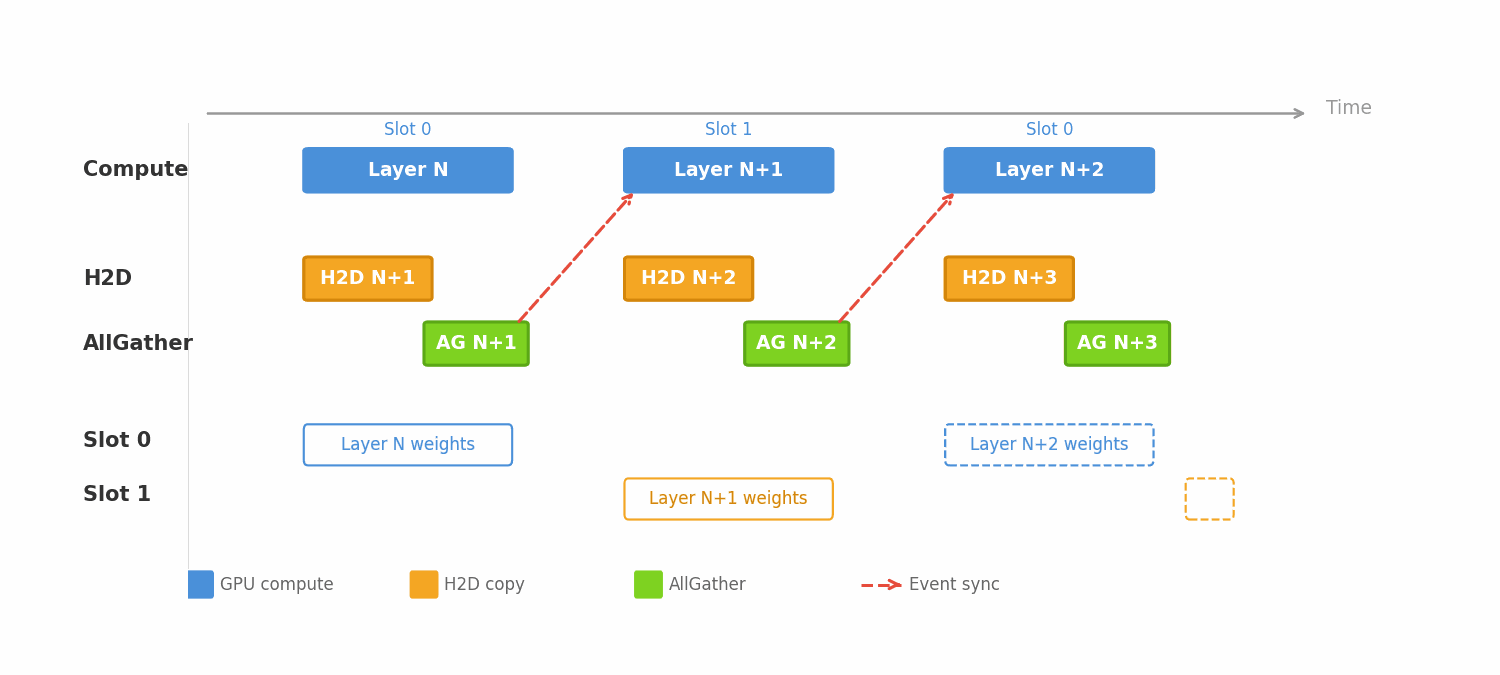
Figure 2: DLO prepares the next layer while the current layer computes. See the dedicated DLO article for the mechanism and deployment trade-offs.
8× B300 BF16 DLO Pareto frontier
On the official BF16 MiniMax-H3 FL2VA checkpoint (5.175 s, 1344×768, SP8/Ulysses8/Ring1/DP1/TP1, AllGather, CUDNN attention), the first request is excluded for lazy CUDA/cuDNN/JIT work and the remaining two requests are averaged. The generated video and audio have the expected output shapes.
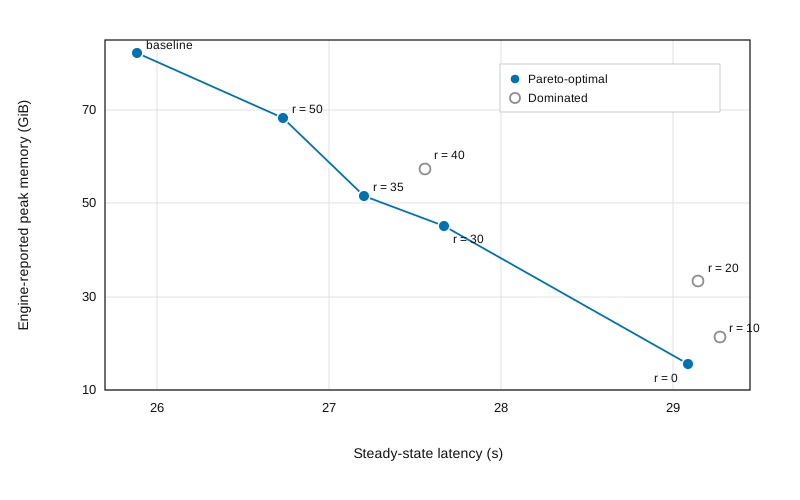
Figure 3: Latency–memory Pareto frontier. r is the number of resident DiT blocks. Filled points are non-dominated measurements; open points are dominated. At r = 35, DLO lowers reported HBM by 37.5% for a 5.1% latency cost; r = 0 is the minimum-memory endpoint.
4.2 Disaggregated encoding
H3 retains approximately 51.5 GB of Qwen3-VL encoder weights in BF16. The disaggregated encoder path moves that one-shot encoder into an independent vLLM stage with its own placement, tensor parallelism, replicas, queue, kernels, and prefix cache. The orchestrator combines its layer-50 hidden states and token-role tags with the original media before the DiT/VAE stage.
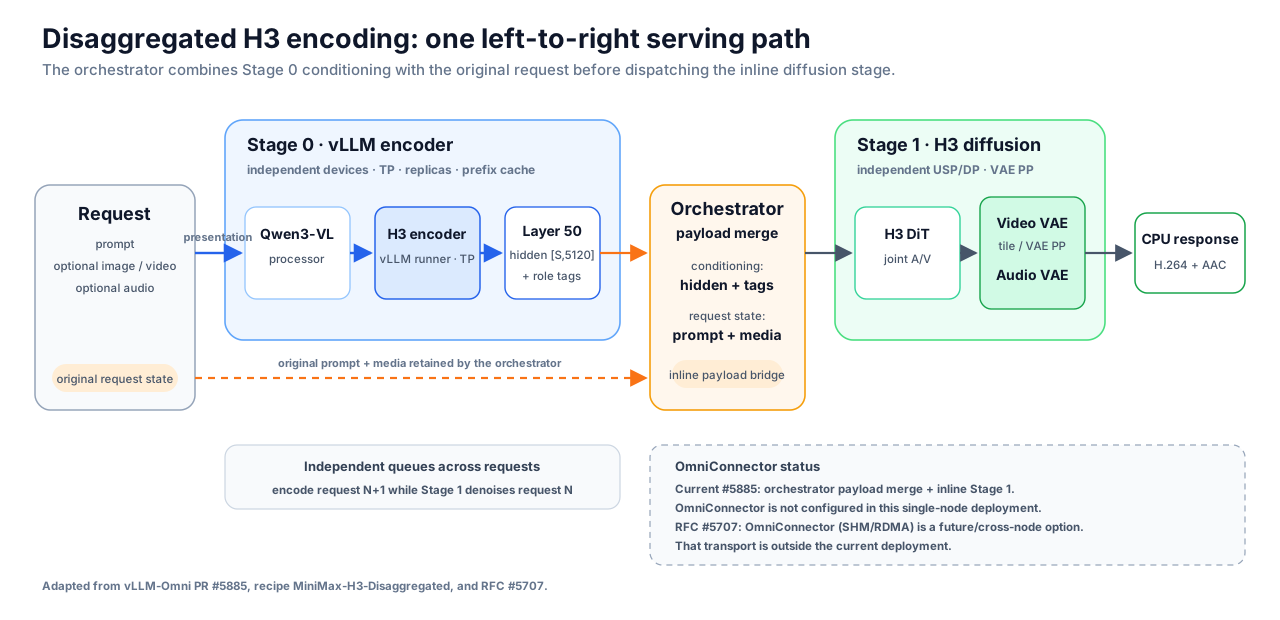
Figure 4: Encoder and diffusion capacity scale independently. The merged single-node recipe returns conditioning through the orchestrator and keeps the diffusion stage inline; it does not configure OmniConnector. SHM/RDMA remains a future cross-node option in RFC #5707.
4.3 Optional quantization and attention acceleration
Section 3 deliberately uses dense BF16 attention and released checkpoint precision. General H3 deployments can select the following additional paths, but each is a separate quality-performance profile rather than a lossless runtime gain.
Weight and activation quantization
- Online FP8. The merged global FP8 path starts from the BF16 checkpoint and quantizes eligible DiT and Qwen3-VL text-decoder linears at load time. Embeddings, norms, RoPE, the vision tower, both VAEs, and precision-sensitive projections keep their declared precision.
- SVDQuant NVFP4 W4A4. The merged offline loader combines an NVFP4 W4A4 base GEMM with a BF16 low-rank correction. Current evidence establishes checkpoint and correctness compatibility; a native fused residual-GEMM performance path remains future work.
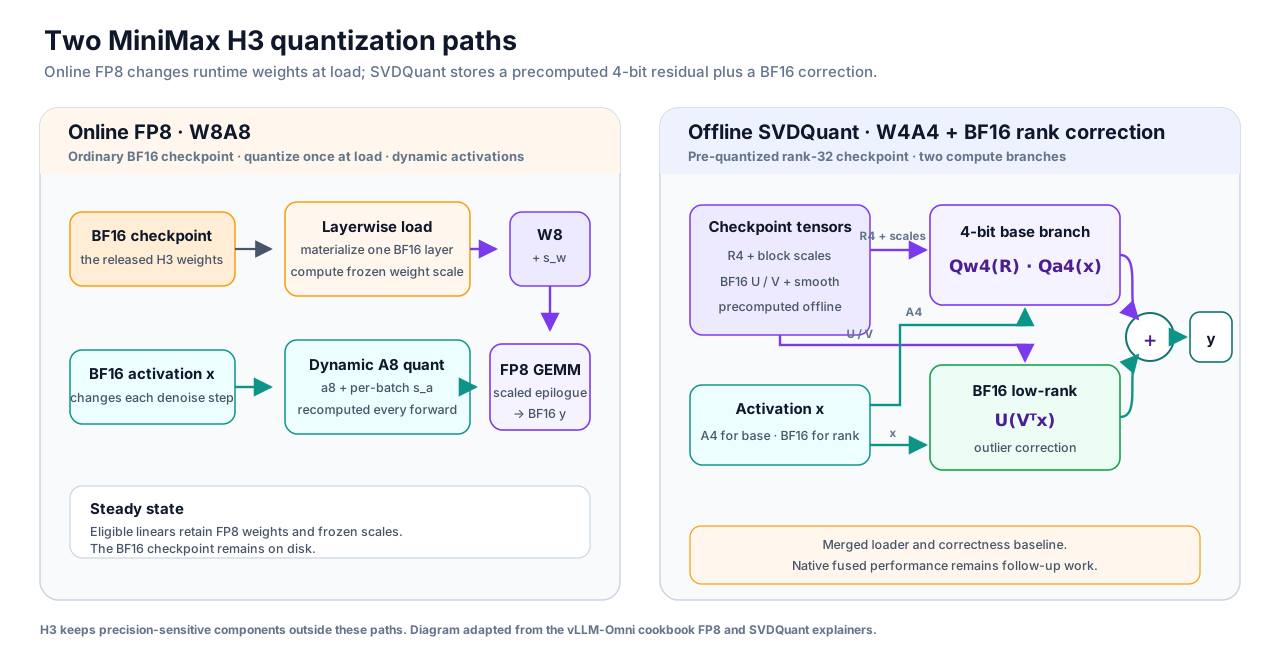
Figure 5: Online FP8 creates FP8 weights and scales at load time, then quantizes eligible activations online. Offline SVDQuant combines an NVFP4 W4A4 base branch with a BF16 low-rank correction. Sources: vLLM-Omni #5910 and #6162, plus the cookbook online FP8 and SVDQuant explainers.
A quantized profile must report peak HBM, startup host RAM, checkpoint storage, latency, and same-seed video/audio quality. A capacity win is not automatically a latency win, and loader correctness is not evidence of a fused-kernel gain.
B300 Online FP8 capacity and latency
The following dense, resident result isolates Online FP8 from the released BF16 checkpoint. Both rows use 8 B300 GPUs, Ulysses8/Ring1 with Fast Ulysses, encoder TP8, VAE PP8 tile decode, CUDNN attention, and the 10-second 1344×768 / 24 FPS request with 50 requested sigma points (49 DiT forwards). One warmup is excluded; each value is the mean of three measured requests. “Stage generation” is the native diffusion-stage timer; E2E is offline client wall time through returned video and audio tensors, excluding MP4 muxing.
| Weights | Stage generation (mean, n=3) | E2E (mean, n=3) | Peak HBM / rank | Result |
|---|---|---|---|---|
| BF16 | 52.572 s | 53.118 s | 87.16 GiB | Lossless baseline |
| Online FP8 | 49.769 s | 50.331 s | 53.27 GiB | 5.3% lower stage time; 38.9% lower peak HBM |
Every measured request returned 243 RGB frames at 1344×768 and 32 kHz stereo audio. Distinct seeds across the three repetitions establish output shape and successful generation, not pixelwise equivalence to BF16.
Quantized and Sparse Attention in TRTLLM_ATTN
TRTLLM_ATTN provides two optional lossy acceleration modes:
- SAGE quantization quantizes both the QK and PV paths to FP8.
- Skip-Softmax uses the QK result to dynamically skip unimportant Softmax and P×V computation.
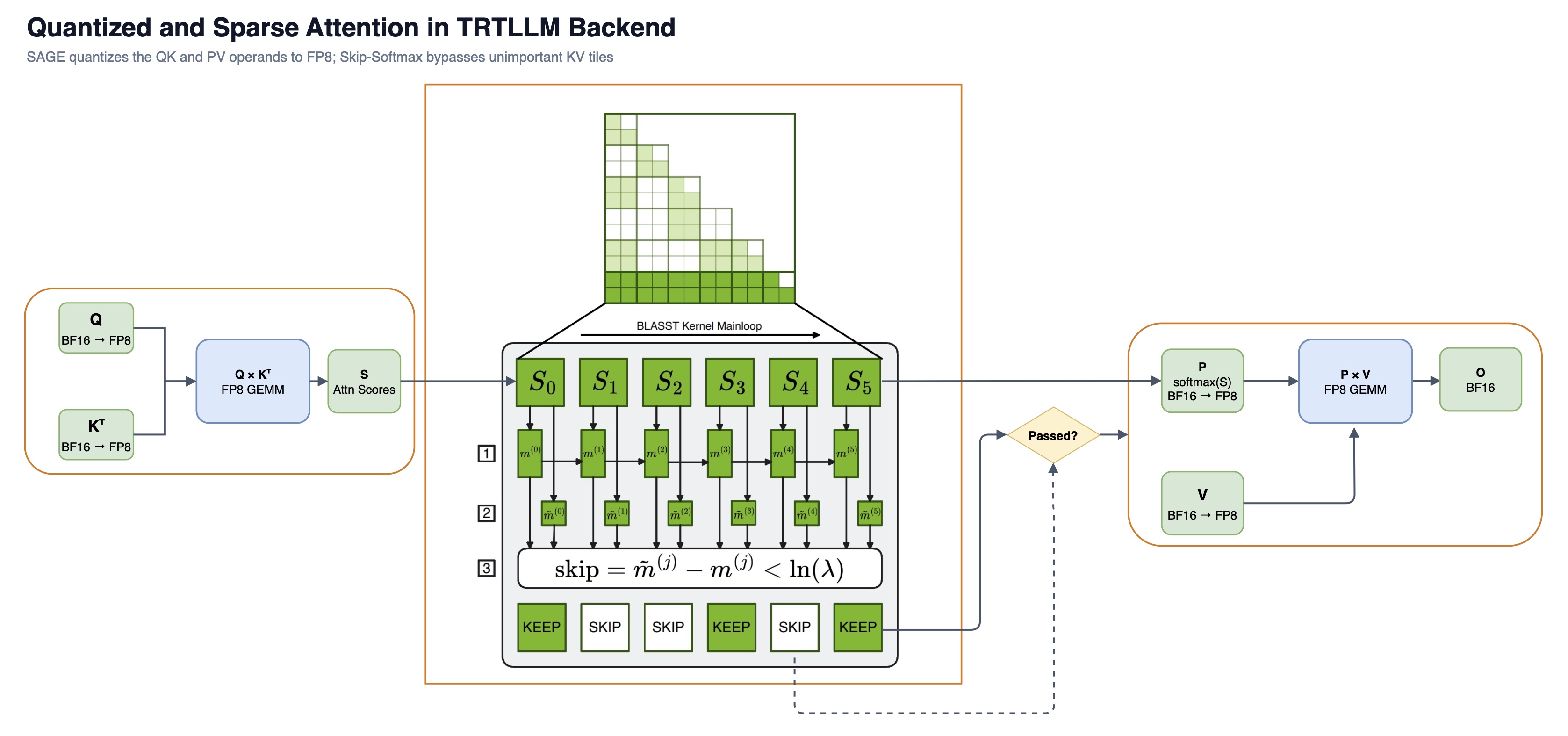
Figure 6: SAGE quantizes Q, K, P, and V to FP8 for Q×K and P×V, while Skip-Softmax uses the BLASST tile-level decision to bypass selected Softmax and P×V tiles.
The following table compares video quality and speedup against the dense, unquantized attention baseline:
| Attention policy | SAGE configuration | Skip-Softmax configuration | Model execution | Speedup | LPIPS vs. baseline |
|---|---|---|---|---|---|
| TRTLLM Baseline | Off | Off | 54.246 s | 1.000x | 0 |
| SAGE FP8 | dtype_qk=fp8_e4m3, q_block_size=1, k_block_size=16 | Off | 44.787 s | 1.211x | 0.3697 |
| Skip-Softmax | Off | threshold 0.05; disabled until 0.97 | 50.029 s | 1.084x | 0.0917 |
| SAGE + Skip-Softmax | dtype_qk=fp8_e4m3, q_block_size=1, k_block_size=16 | threshold 0.05; disabled until 0.97 | 43.867 s | 1.237x | 0.3750 |
The measured Skip-Softmax configuration is conservative for preserving video quality. Users can choose a higher threshold or enable Skip-Softmax for more denoising steps to trade quality for additional speed. The TRTLLM attention guide documents the controls.
Cache-DiT
Cache-DiT is a
request-level cache policy rather than an attention backend. For H3,
quality=high enables dynamic per-step reuse, while quality=lossless
restores the reference path. Its hit/miss behavior is deployment-dependent, so
it requires independent latency and quality qualification and is not included
in the attention A/B above.
4.4 Compatibility boundaries
| Combination | Status for this article |
|---|---|
| Base H3 + DLO | Supported through the maintained H3 recipes; qualify the selected topology locally |
| Base H3 + DLO + online FP8 | Supported, including the AllGather path through #6279; performance and quality still require local qualification |
| Base H3 + disaggregated encoder | Merged single-node path |
| FastH3 + DLO | Unsupported: FastH3 fusion occurs in load_weights(), while offload installs a different host-weight path |
| FastH3 + VSA | Supported on CUDA with the matching VSA artifact, fastvideo-kernel, FASTVIDEO_VSA, and local or pure Ulysses attention; Ring and AllGather SP are rejected |
| FastH3 + disaggregated encoder | Not yet qualified; it was not used for the reported FastH3 result |
Step execution sidebar. H3 can admit and abort requests between denoise steps (#5810), but existing co-batching tests did not improve latency. Request mode remains the recommendation while cancellation/reclamation and small under-utilized workloads are investigated in issue #5700.
5. From system optimization to FastH3
FastH3 is FastVideo's four-step DMD2 student of MiniMax H3. It reuses the H3 encoder, video VAE, audio VAE, tokenizers, and schedulers, but reduces the denoising loop to four transformer forwards over five sigma positions. vLLM-Omni supports both the Dense/Data-Free artifact and the recommended VSA/Data-Free artifact.
The integration is a collaboration across two layers:
- FastVideo develops and releases the distilled student and adapter artifacts.
- vLLM-Omni validates the artifact, fuses it while the checkpoint streams in, shards the fused weights, and serves it through the optimized attention, VAE, transport, and MP4 path.
FastH3 is not a normal request-switchable LoRA. Besides low-rank factors, its artifact carries full-rank deltas and replacement weights that an ordinary LoRA layer cannot represent. vLLM-Omni therefore fuses the artifact before sharding rather than activating it per request.
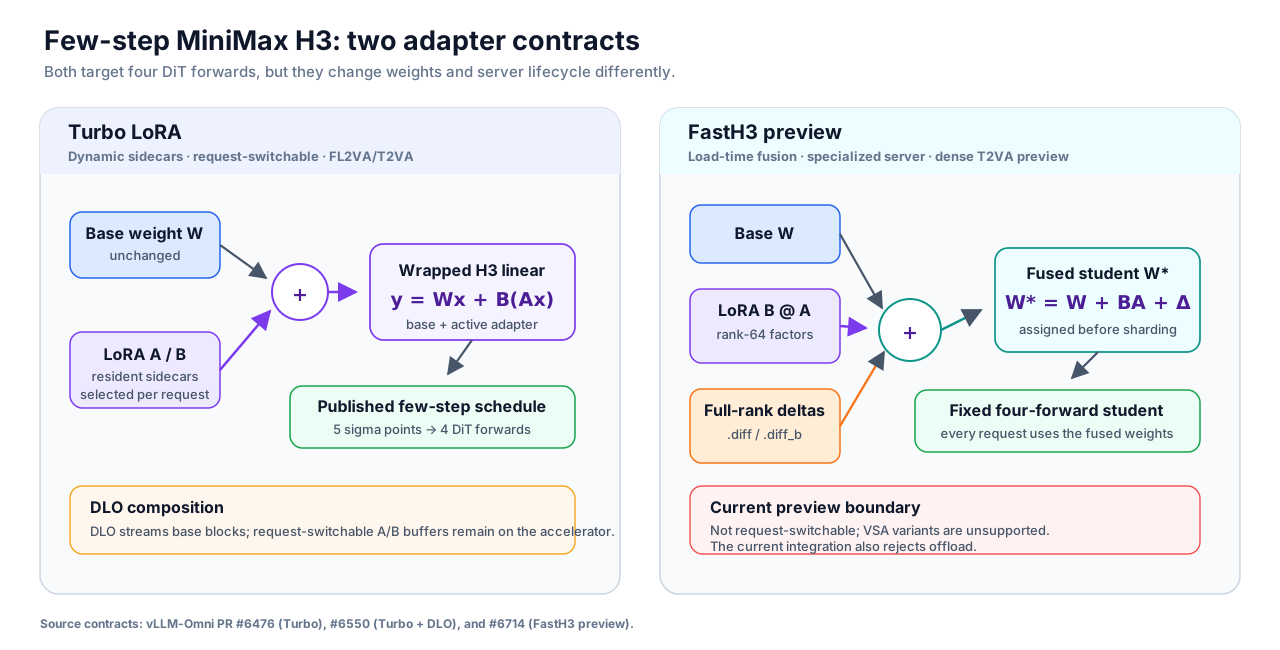
Figure 7: Turbo leaves base weights unchanged and applies request-selected A/B sidecars. FastH3 fuses low-rank and full-rank changes into a dedicated student before sharding. Sources: Turbo #6476, DLO support #6550, and FastH3 integration #6714, with VSA and Ulysses support in #6909.
| Profile | Activation model | Task scope | When to choose it |
|---|---|---|---|
| Base H3 | Released checkpoint | T2VA, FL2VA, Ref2VA | Full task coverage and compatibility with the general scaling lane |
| Turbo | Request-switchable adapter | T2VA and FL2VA | One service needs request-time switching or FL2VA |
| FastH3 | Load-time-fused dedicated student | Dense/Data-Free or VSA/Data-Free T2VA | Lowest validated latency on a dedicated T2VA endpoint; VSA optionally sparsifies the main DiT attention |
FastH3 v1 accepts T2VA only, requires its four-forward schedule and checkpoint flow shifts, rejects offload, and cannot accept another request-time LoRA. Its VSA variants additionally require CUDA, the external FastVideo kernel package, and local or pure Ulysses sequence parallelism. These are serving contracts, not tuning suggestions.
6. Real-time FastH3 serving on B300
This section reports the absolute FastH3 result on vLLM-Omni 86b85c07. It
does not divide by the base H3 result from a different source/prompt/seed.
6.1 Pin the artifact
The measured Dense/Data-Free artifact is pinned to Hugging Face revision
bcf40ca6f457ed66f8badf13514943e390205fca:
FASTH3_REV=bcf40ca6f457ed66f8badf13514943e390205fca
FASTH3_DIR=/models/FastH3-LoRA

hf download FastVideo/FastVideo-FastH3-4-step-Preview-v1-LoRA \
  dense-datafree/adapter_model.safetensors \
  --revision "$FASTH3_REV" \
  --local-dir "$FASTH3_DIR"

echo "4ce198c83132251b7fd0de2503823aa49c53983f068318f66cb19eaefb7fcc12  $FASTH3_DIR/dense-datafree/adapter_model.safetensors" \
  | sha256sum -c -
The adapter is 1,485,626,152 bytes. Pin both the repository revision and file
checksum; the repository name still contains Preview-v1, while the matching
vLLM-Omni integration is merged.
6.2 Serve and request
CUDA_VISIBLE_DEVICES=0,1,2,3,4,5,6,7 \
VLLM_WORKER_MULTIPROC_METHOD=spawn \
VLLM_OMNI_VIDEO_SYNC_TIMEOUT=1800 \
vllm serve "$H3_MODEL" --omni \
  --host 127.0.0.1 --port 8095 --trust-remote-code \
  --task-type fl2va --served-model-name MiniMaxAI/MiniMax-H3 \
  --num-gpus 8 --usp 8 --ring 1 --ulysses-a2a-permute \
  --text-encoder-tp-size 8 \
  --vae-patch-parallel-size 8 --vae-parallel-mode tile --vae-use-tiling \
  --diffusion-attention-backend TRTLLM_ATTN \
  --lora-path "$FASTH3_DIR/dense-datafree/adapter_model.safetensors"
curl -sS -X POST http://127.0.0.1:8095/v1/videos/sync \
-F 'prompt=In a snowy blue-purple forest, Ori carefully walks past a sleeping giant; footsteps crunch in the snow while the creature breathes and softly snorts.' \
-F 'width=1344' -F 'height=768' -F 'aspect_ratio=16:9' -F 'fps=24' \
-F 'num_inference_steps=4' -F 'seed=1101' \
-F 'extra_params={"task":"t2va","duration":10.0,"flow_shift":12.0,"audio_flow_shift":3.0}' \
-o fasth3_10s.mp4The service uses one FastH3 replica, encoder TP8, DiT DP1 x TP1 x USP8 with
Ring1 and Fast Ulysses, VAE PP8 tile decode, TRTLLM_ATTN, and the
standard compact output/MP4 path.
6.3 Ten-second critical path
Profiler timers come from a separate instrumented pass; clean E2E carries the latency claim.
Raw benchmark bundle — pending publication gate. The stable bundle has not yet been published. Before publication, this evidence-handoff requirement must be replaced by a bundle URL containing raw clean/profiler samples, logs, the environment manifest, media metadata and hashes, and topology evidence for both the critical-path row and duration sweep.
| Encoder | DiT total / 4 / per-forward | Video + audio VAE | Derived transport | CPU MP4 | Profiled E2E | Clean E2E | Peak HBM |
|---|---|---|---|---|---|---|---|
| 0.052 s | 5.532 s / 4 / 1.383 s | 1.247 s combined | 0.881 s | 0.868 s | 8.629 s | 8.678 / 8.710 s | 94.1 GiB/GPU reserved |
6.4 Five-, ten-, and fifteen-second sweep
The sweep holds prompt, seed, resolution, artifact, schedule, topology, attention, VAE, output path, and CPU affinity fixed. H3 aligns the requested durations to 124, 243, and 362 frames.
| Requested / aligned | Video / audio duration | DiT total / per-forward | Combined VAE | Transport + MP4 | Clean E2E | Client RTF | x real time |
|---|---|---|---|---|---|---|---|
| 5 s / 124 | 5.167 / 5.175 s | 2.806 s / 0.702 s | 0.637 s | 0.929 s | 4.602 / 4.396 s | 0.889 / 0.849 | 1.125 / 1.177 |
| 10 s / 243 | 10.125 / 10.125 s | 5.532 s / 1.383 s | 1.247 s | 1.749 s | 8.678 / 8.710 s | 0.857 / 0.860 | 1.167 / 1.163 |
| 15 s / 362 | 15.083 / 15.083 s | 9.517 s / 2.379 s | 1.861 s | 2.484 s | 14.177 / 14.059 s | 0.940 / 0.932 | 1.064 / 1.073 |
All six measured requests satisfy RTF_client <= 1.0: complete-MP4 generation
is faster than playback for every tested duration.
FastH3 Dense versus VSA
A separate matched study in
#6909 compares the
Dense/Data-Free artifact with the recommended VSA/Data-Free artifact on
8×B300 at 1344×768 and 24 FPS. Both use four transformer forwards, pure
Ulysses 8, and one discarded warmup; each result below is one measured request
per backend and duration. Dense uses TRTLLM_ATTN; VSA uses
FASTVIDEO_VSA, top-k 64, and the Triton kernel path.
| Request | FastH3 Dense server E2E incl. MP4 | FastH3 VSA server E2E incl. MP4 | Speedup |
|---|---|---|---|
| 10 s | 9.838 s | 7.278 s | 1.35× |
| 15 s | 14.199 s | 10.800 s | 1.31× |
These server-side measurements establish the matched VSA speedup; they use a different source revision and timing boundary from the client E2E duration sweep above. See the maintained MiniMax H3 recipe for the VSA installation, launch command, and fallback checks.
6.5 Representative outputs and quality boundary
These supplied FastH3 outputs cover the same 5/10/15-second duration classes. They are 1280x736 representative examples, not the 1344x768 timing artifacts used in Section 6.4.
| Request | Frames | MP4 duration | Resolution / FPS |
|---|---|---|---|
| 5 s | 124 | 5.184 s | 1280x736 / 24 FPS |
| 10 s | 243 | 10.144 s | 1280x736 / 24 FPS |
| 15 s | 362 | 15.104 s | 1280x736 / 24 FPS |
These clips are presentation examples. The publication-grade timing and media evidence remains subject to the raw-bundle gate in Section 6.3.
| Quality gate | Status |
|---|---|
| Repeated same-seed FastH3 output | Byte-identical in the measured runs |
| Media structure | Expected frames/FPS, H.264, stereo AAC, nonzero video/audio signal |
| Matched base-versus-FastH3 multi-seed quality | Pending; no parity claim |
Reducing denoising exposes the new tail: on the 10-second profile, combined VAE, derived transport, and CPU MP4 account for roughly three seconds in the instrumented path. RFC #6872 proposes overlapping VAE chunks, D2H/IPC, and encoding rather than optimizing these stages in isolation. For this B300 profile, its optimistic ceilings are approximately 0.87 seconds (about 10% E2E) when overlapping transport with encoding and 1.75 seconds (about 20% E2E) when also overlapping incremental VAE decode; the corresponding go/no-go targets are at least 5% and 10% E2E. Related draft PR #6885 reports a 0.8847-second (26.57%) VAE-to-complete-MP4 reduction on a four-L20X feasibility run with exact media parity, not a B300 production-serving result.
7. Production guidance and limitations
The deployment choice is now concrete:
| Requirement | Recommended profile |
|---|---|
| Full T2VA, FL2VA, and Ref2VA coverage | Base H3 with the system-wide stack |
| Request-time adapter switching or FL2VA with four-forward Turbo | Separate Turbo service |
| Lowest validated T2VA complete-response latency | Dedicated FastH3 service from Section 6 |
| Matched sparse-attention acceleration for FastH3 T2VA | Dedicated VSA/Data-Free service with the constraints above |
| Host-memory-driven fit or independently scaled encoder capacity | Base H3 DLO or disaggregated-encoder lane; qualify locally |
FastH3 VSA is supported only with its matching artifact, CUDA kernel package,
FASTVIDEO_VSA, and local or pure Ulysses attention. Do not combine either
FastH3 profile with DLO, quantization, cache policies, Ring/AllGather sparse
attention, or encoder disaggregation without a new correctness, quality,
memory, and latency qualification. The living
feature compatibility tracker
records cross-feature work, but it can lag merged implementation. Verify the
linked PRs and maintained recipes before selecting a production combination.
MiniMax H3 uses the MiniMax H3 Community License Agreement. Commercial and hosted-service operators should review its current territorial, attribution, revenue, acceptable-use, and safeguard requirements with counsel.
For post-training, vLLM-Omni can also serve H3 rollouts in VeRL-Omni; training is ecosystem coverage rather than part of this serving benchmark.
8. Conclusion and focused future work
System-wide optimization makes the complete H3 pipeline efficient. FastVideo's four-forward student then moves the dedicated T2VA profile into faster-than-playback complete-response generation on the measured B300 system.
The remaining work follows directly from that progression:
- qualify the native FastVideo SM100a VSA kernel across target Blackwell systems and integrate native fused NVFP4 kernels;
- integrate and qualify the Sol-Attn on-the-fly sparse-attention backend across target Blackwell platforms and multi-seed workloads;
- complete a matched base/FastH3 multi-seed quality evaluation;
- implement the chunkwise VAE-to-transport-to-MP4 pipeline and qualify a GPU encoder;
- enhance MiniMax H3 post-training integration across VeRL-Omni, UniRL, and RLinf, with scalable rollout serving, explicit resource placement, and end-to-end training validation; and
- qualify FastH3 composition with encoder disaggregation or other scaling features rather than inferring compatibility.
Acknowledgments
This work builds on contributions across vLLM, vLLM-Omni, VeRL-Omni, MiniMax H3, FastVideo, FastH3, Diffusers, and NVIDIA. We especially thank the FastVideo team for open-sourcing FastH3 and collaborating with the vLLM-Omni community on the merged serving integration.
We thank @Isotr0py for base H3 support; @lishunyang12, @evanchueng, @Gaohan123, and @david6666666 for DLO, base integration, and online-FP8 work; @gcanlin and @yuanwu2017 for encoder disaggregation; @bobboli, @fan2956, @mo-ke-ke, @mglyn, @MosCloud, and @ultism for attention, fused kernels, quantization, VAE, transport, and media paths; @princepride for FastH3 integration, B300 validation, and VSA/Ulysses support; and @NancyFyong and @mengchengTang for VeRL-Omni integration.
Special thanks to Hongsheng Liu and Roger Wang for general support and blog preparation.
Appendix A. Reproducibility
A.1 Timing hierarchy
The vLLM-Omni measurements are nested; parent and child values must not be added together:
| Boundary | Scope |
|---|---|
| Client | Request submission through complete MP4 receipt |
| Request | Orchestrator lifetime across stages |
| Stage | One independently scheduled engine/device group |
| Engine | Queue, model execution, output-ready wait, and formatting |
| Profiler | Prompt, DiT, and VAE method boundaries inside engine execution |
| Server | H.264/AAC encode and mux after the final stage |
Per-forward denoise time divides by the actual DiT forward count, not the requested sigma-position count. Profiler values come from separate diagnostic requests and do not replace unprofiled client latency.
A.2 Base H3 vLLM-Omni reproduction
CUDA_VISIBLE_DEVICES=0,1,2,3,4,5,6,7 \
VLLM_WORKER_MULTIPROC_METHOD=spawn \
VLLM_OMNI_VIDEO_SYNC_TIMEOUT=1800 \
vllm serve "$H3_MODEL" --omni \
  --host 127.0.0.1 --port 8093 --trust-remote-code \
  --task-type fl2va --num-gpus 8 --usp 8 --ring 1 \
  --ulysses-a2a-permute --text-encoder-tp-size 8 \
  --vae-patch-parallel-size 8 --vae-parallel-mode tile --vae-use-tiling \
  --diffusion-attention-backend TRTLLM_ATTN
The canonical request uses the prompt and seed in Section 2, 50 requested sigma points, flow shift 12, audio flow shift 3, and a 10-second target.
References
- vLLM-Omni repository
- FastVideo repository
- FastH3 technical overview
- FastH3 four-step adapter
- FastH3 VSA and Ulysses integration
- MiniMax H3 model
- Diffusers MiniMax H3 pipeline
- MiniMax H3 serving recipe
- Distributed Layerwise Offload
- Feature compatibility tracker
- Chunkwise output pipeline RFC
- VeRL-Omni repository
- UniRL repository
- RLinf repository